Thursday, February 28, 2013

Galileo's Moons


If I could sail a thousand miles;
Just to be with you.
I’d navigate to the stars above,
and Galileo’s moons.
Polaris and the Southern Cross,
Are stretched so far and wide.
They light my path and give me hope;
I’ll have you by my side.

When seas are calm I hoist my sails;
And bid a fond farewell.
Then soon enough the skies grow dark,
As seas begin to swell.
It matters not how long it takes,
The danger or the gloom.
For on starry nights your face appears
In Galileo’s moons.

I’ve sailed so long; I’ve sailed so far;
The days turned into years.
In all that time I’ve kept my faith;
And pushed aside my fears.
My compass is my aide-de-camp;
My mast and rudder too.
And when it’s dark I search the skies,
For Galileo’s moons.

When I was young I hatched a plan
The dream I tried to hide.
But life took hold and swept me up
And took away my pride.
Now here I stand alone and old;
My heart still young and true.
If I reach your shores its thanks alone
To Galileo’s moons.

I wrote this poem back in 2011 after I'd read a beautiful book called "Galileo's Daughter" by Dava Sobel, one of my favorite non-fiction authors. Inspiration can come from almost any source!


Announcing Giveaway for Spy Island

Visit my friend Larissa's review blog, The Howling Turtle, for a special March giveaway for Spy Island:
     http://howlingturtle-pdx.blogspot.com/

And please let me know by commenting how you like the cover.
Thanks!
Sophie


Monday, February 25, 2013

A Glimpse at Some Locations in Spy Island

This post is for readers who are interested in seeing what some of the locations in the novel look like. Since the 1917 transfer of the Danish West Indies to the US, the islands have not changed significantly in appearance, so these pictures give a good idea of life looked like back during colonial days. I took these pictures during my "location scouting" trip in August 2007, when the average temperature was a sweltering 95°F and most of the islanders were hiding out on the beach.

This is the pavilion in Emancipation Park where the pivotal assassination scene takes place. This park is only a short distance from Fort Christian, which was undergoing renovations during my visit and was gated off to the public. I daresay I look pretty confident for a person about to embark on a major, life-changing event, although I wasn't aware of it at the time!

 
These scary-looking cannons line the driveway of Bluebeard's castle. I suppose at one time or another they were fired at marauding pirate ships and privateers, but in these less-dramatic times, the harbor is mostly bombarded with cruise ships and rich yachts filled with eager tourists.

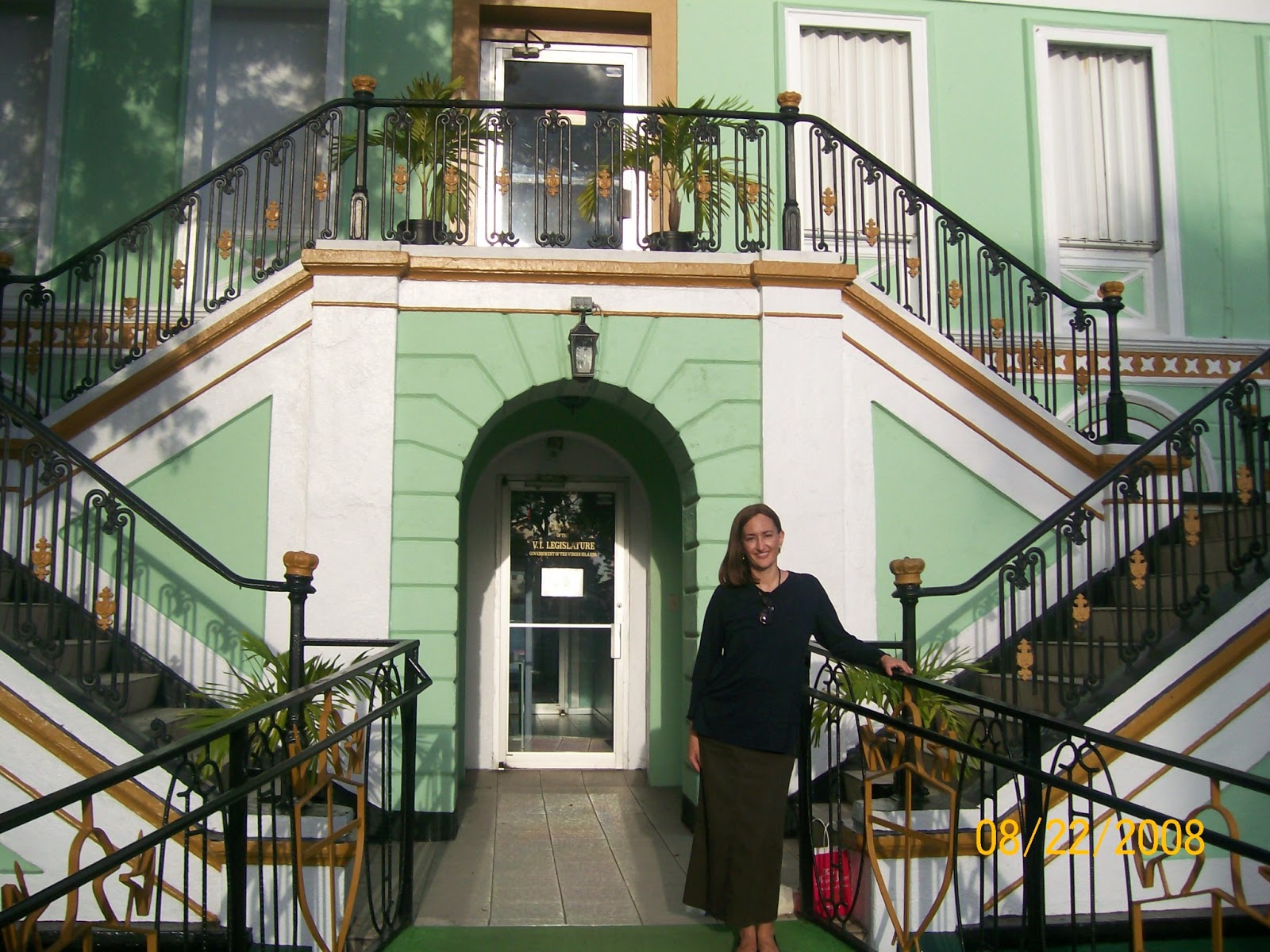
The Barracks that once held the Danish Gendarmes now houses the V.I. Legislature. Gone are the blue-suited soldiers with shiny swords and revolvers. They've been replaced with the symbol of our generation: over-worked, harried bureaucrats armed with cellphones and Ipads. My how times have changed!

This house on Synagogue Hill was my inspiration for Abby's house. It has a large, sweeping veranda, a beautiful, panoramic view of the harbor, and lots of mysterious doors leading to secret locations.
The Famous Market Square and behind it, the former National Bank of the Danish West Indies, the site of some tense scenes with the mad Voodoo Queen-bamboula dancer, Queen Coziah, whose real-life identity remains a mystery even to this day.
A bedroom in the Haagensen House Museum (a restored Danish house from colonial days) provided tremendous inspiration for Abby's room with its West Indian mahogany furniture, four-posted bed, vanity table, old pictures, and large, jalousied windows.
The Grand Hotel has not been a working hotel in 40 years, but it stands as a reminder of what life was like back in Danish Times, quieter, simpler, less congested. Exactly the kind of life many of us would love to return to!

A Creole kitchen from the 19th Century. You can imagine all the arguing and bickering that must have gone on in this kitchen over the proper way to make kallaloo!
I hope you enjoyed this little tour. If you should ever find yourself in the town of Charlotte Amalie, keep an eye out for Queen Coziah; she's been known to make sudden appearances from time to time:)

Sunday, February 17, 2013

What writers can learn from Slumdog Millionaire

As a writer, I envy people who work in teams. Working in a team is empowering. By collaborating with others, the individual becomes a part of something greater, and when they succeed, their success is shared collaboratively. A writer's success, if he ever experiences any, is one-sided and can never really be shared, making it somewhat hollow. 

The team naturally benefits from synergy, the combined efforts that every member brings to the table, causing the team to become greater than the sum of its parts. But most writers don't have the option of working as a team. A writer’s work is lonely, frustrating, and oftentimes isolating. By definition, writers work in a world they have created in their own imagination. The hours are long, the rewards minimal, and finishing a project seems light years away. There are many days when the writer cannot rely on his sense of humor, because it's non-existent. There are days he can't rely on his strength, because it has ebbed. There are days when he won’t be able to rely on his natural optimism because it has dissipated.

So what does he do?

On days when my positive thinking and physical strength have evaporated, when I have lost my self-confidence, and when the spark of inspiration has dried up, I watch an inspiring video that never fails to move me. On YouTube, there is a video that captures the moment when "Slumdog Millionaire" wins Oscar for Best Picture. Each time I watch that video, I cry. The pride, the joy, the camaraderie, the teamwork, the collaborative effort between the writers, actors, technicians, producers, and director is right there on the stage. Their mutual effort has paid off stunningly by garnering them the industry's highest prize.


My happiness for them overwhelms me because when the underdog wins, all of us win. When "Slumdog Millionaire" won the Oscar, they were the odd man, but they broke new ground in film making at a time when nobody believed in them and nobody would give them a chance. Each and every day of his working life, a writer must do the same. When he sits down at his computer, he has to believe he is breaking new ground. He has to believe in his work and commit himself to it fully each new day. He must write with the idea that he is creating something new, monumental, and worthwhile, something the world is happily waiting for.

In the words of Producer, Christian Colson, "If you have passion and belief, truly anything is possible." Dear writers, heed the words of Christian Colson. Believe in yourself and keep your passion for writing alive. But above all, keep writing. Sometimes the strongest team is a team of one.

Now watch the video and crank up those engines!
Go #NaNoWriMo2019!!! I'll meet you at the finish line!


Monday, February 11, 2013

New Cover Reveal for Spy Island

I am pleased to present the new cover for Spy Island. Does the girl look like she's hiding a dangerous secret in her basement? Does she look capable of bringing down an entire nest of German spies? Read Spy Island to learn the answers to these questions!

Also, check out this awesome review by Jenn Ritter of Jennation Book Reviews:
http://jennation-reviews.blogspot.com/

Let me know what you think!!

Sunday, January 20, 2013

Brian Finnegan's Writing Tips

Brian_Finnegan
Reblogged from:  http://www.novelicious.com/2012/10/brian-finnegans-writing-tips.html

Some excellent writing tips today, courtesy of Brian Finnegan. Our full interview with Brian is here.
1. Get a good concept.
You want to be published? Concept sells.
Stephen King calls it the ‘What if…’ as in ‘What if a woman with too much pride fell in love with a man who was prejudiced against her? (Pride and Prejudice); or what if a group of people who got fired from their jobs on the same day formed a film club together (The Forced Redundancy Film Club). Coming up with a sellable concept isn’t easy, but if you are attuned to the idea, you never know what will come your way. Try to reduce the concepts of your favourite novels to one sentence, to get an understanding of what a good concept is. Read lots of true-life stories in newspapers and magazines; keep an eye out for interesting headlines, really listen when people are telling you stories about their lives or about other people. It’s a way to tune into concept. You never know what might come to you when you’re listening out for it.

2. Find a character you love.
My first book is a multiple-narrative, but I would not recommend it. Don’t be worried that you won’t have enough story. If you’ve got a good concept, you’ll find enough plot. The main thing you need to drive your book forward from the start is a lead character you really love, so you can enjoy writing about her story, her thoughts, feelings and actions. Think about the people you really like. What good qualities do they have in common? What contradictions are there in their characters that you notice? Make your lead a composite of the people you love.

3. Learn the Three-act Structure
Most stories come in three acts. In the first act we are introduced to the character and to what is happening in her life. We learn what the character wants (a character must always desperately want something). At the end of the first act, the character will set out to get what she wants.
In the second act, the character pursues what she wants only to be faced with ever increasing (and seemingly insurmountable) obstacles, which she will react to and then overcome. At the end of the second act, the character will have seemingly overcome the biggest obstacle of all and be on her way to a happy ever after.
In the third act, an even bigger obstacle (hugely insurmountable) will be thrown in your character’s way. She will either overcome it or not at the end of Act 3, and in the process will learn something about herself.

4. Find an ending
What do you want to happen to your character at the end of the book? You may say something like ‘I’d like her to live happily ever after’. But what will it take for her to live happily ever after (at least in the imagination of the reader)? The ending doesn’t have to be happy (although I would suggest that in commercial fiction, an unhappy ending will leave your readers feeling unhappy about your book.)
Pride and Prejudice has a happy ending. In order to be happy, Elizabeth overcomes her pride to accept Darcy’s love. Darcy overcomes his prejudice to accept Elizabeth as she is. In The Forced Redundancy Film Club, Katherine is forced to drop all artifice and come to terms with the loss of her father, in order to find love and her happy ever after.
Do you want your character to achieve what she wants? Do you want her to achieve something different and realise what she wanted was not what she actually needed all along? What would ultimately solve the personal difficulties you’re character is experiencing at the very beginning of the story?

5. Forward Motion Only
Your goal at the beginning should be to get a first draft down. Don’t worry about small details, just tell your story in broad strokes. At the beginning of each writing session go over what you wrote the day before, but not with a fine-tooth comb. Just get reacquainted with it before you forge ahead. When you’ve written your first draft, you’ll have a document to really hone and work on. No book comes out of a writer perfectly, and no book ever gets written if a writer wants it to be perfect from the first off.

Thursday, January 17, 2013

Announcing Goodreads Giveaway for Spy Island


Enter to Win a Free Copy of Spy Island by Visiting Goodreads Feb. 1st - February 28th! Good Luck!

Goodreads Book Giveaway

Spy Island by Sophie Schiller

Spy Island

by Sophie Schiller

Giveaway ends February 28, 2013.
See the giveaway details at Goodreads.
Enter to win